
“We ate well and cheaply and drank well and cheaply and slept well and warm together and loved each other.” ― Ernest Hemingway, A Moveable Feast
“That’s your chair,” I said as I motioned to a leather-backed armchair at my favorite table in Café Tortoni. “I wouldn’t let anyone sit there. No one. I didn’t care how important they were. Or how famous they were. I was superstitious about it. I always hoped you would come back. I wished for you to come back. And here you are. Yes, that’s your chair. And for this one extraordinary moment, everything is perfect in the world.”
I was exhilarated to be in Buenos Aires with Izzy for our extended honeymoon. I wanted to show her everything I experienced during the year I spent without her. I had missed her terribly. And I tried to fill the chasm of my grief with intellectual and creative quests. I studied Italian. I learned to dance the Argentine tango. I met interesting people.
I traveled to Patagonia with the poet Silvina Ocampo. I savored every syllable as Jorge Borges recited one of his poems to me, first in Spanish and then in English. I immersed myself in the words and thoughts of Alfonsina Storni. And I read armloads of books, many of them at my table at Café Tortoni, where there was always an empty chair beside me, waiting for Izzy’s return.
Then, she was there. She was sitting beside me. In her chair.
Izzy looked comfortable in her seat as she annotated the Agatha Christie novel The Clocks that she bought a few days earlier at La Librería de Ávila, the oldest bookstore in the city. Izzy was an avid admirer of Hercule Poirot, which probably explained her prodigious powers of deduction and intuition. I watched with great fascination as she inscribed notes in the page margins and underlined passages while she sipped her hot chocolate. I had visualized her in that chair a hundred times. But to be sitting next to her, absorbing every nuance of her, was nearly overwhelming.
Every rare once in a while in our lives, the real thing is more potent than the fantasy.
What I didn’t anticipate – what wasn’t part of my imagined time with her in my café – was that Izzy was going to have a burst of creative inspiration that would once again change the trajectory of our lives. My fantasy was that we would go to milongas and tango late into the night. Then make silent love in the madrugada when we skulked back to our room just before dawn.
We did.
We also rose early and spent most mornings at my favorite table in Café Tortoni. I was delighted to see many of my Argentine friends there. And somewhat remarkably, I was able to get my same table, as always. Argentinians are fiercely loyal. And passionate. Once you’re genuine friends with them, you’re friends for life. It didn’t matter that I had been gone a year; it was as if I just left yesterday. My table was mine once again.
“I have wondered what you did here during that time,” Izzy said. She had an insatiable curiosity. She wanted to know everything, and her questions were unceasing. “I see that you know people. Thank you for introducing me. What else did you do?”
“Look at this,” I said as I reached in my leather satchel and pulled out a thick stack of letters in envelopes cinched with red silk cord secured by a bosun’s whistle knot. “I wrote letters to you while I sat here. But I didn’t have the courage to send them. I thought you were getting married in Padua. So, I carried them around with me. And this place, and this moment, feels like the right time for you to have them.”
Izzy picked up the bundle of letters and paused. Most people would have untied the knot and pulled the letters from their envelopes. Or flipped the bundle in their hands. Izzy raised the letters to her face, closed her eyes, and inhaled deeply.
“I can smell you in these letters,” she said as she leaned close to me. “It’s the one thing that always brings me back to you. Whenever we’re apart, I think about the scent of you.”
As much as I wanted to leave right then, we, instead, spent the entire day at our table at Café Tortoni reading and discussing the letters I wrote to Izzy from Buenos Aires. She didn’t want to rush through them. She carefully opened each letter and smoothed it flat. She examined every detail – my handwriting, the color of the ink, the watermark on the paper – and then commented on each aspect. After she spent several minutes scrutinizing a letter like Poirot, she then made tiny pencil marks by the coordinates I added in the headers. Then the barrage of questions came about every facet I wrote about. She wanted to know about people and places and foods and dance steps. Details. It made my pulse race when she said, “Tell me something I don’t know about you.” It was always her favorite question.
Izzy teased me by asking how well I knew the remote past tense in Italian. It’s not used often in spoken Italian, but she pressed me on it. Then she looked sufficiently pleased when I was able to tell her some of the stories of my time in Buenos Aires while speaking in a very particular Italian verb form that indicated an unspecified time in the past. Izzy loved to startle me and challenge my mind. I vowed to keep learning. And since I was back in Buenos Aires, I made a note to send a telegram to my Italian language tutor. I was looking forward to seeing her. She was extraordinary.
Izzy elided easily into the intellectual society in the Alfonsina Storni Salon. She enjoyed speaking Spanish, and so did I. There was a magic in the easy flow of the days. One topic of discussion in the Salon was how we, as an artist community, could encourage more art and artists in Buenos Aires. And beyond.
“It’s an opportunity to nurture creativity,” Izzy said to the group one morning in May. “We could create a space for artists to create and display art. And art doesn’t have to be just painting. It could be photographs. And ceramics. And reading. And music.”
I knew we were on the precipice of something new and exciting. And we had the resources to make it a reality.
“Il Patrizio left us an endowment that will allow us to fund a foundation,” Izzy said. I could see a few people around the table make a gesture by quivering one hand that was the quiet Argentinian version of appreciation. “We can start today.”
When we returned to our hotel, I had something else on my mind. But Izzy wanted to plan. Before we left the hotel that morning, she asked the concierge if he could secure architectural paper and a selection of drawing pencils. And an architect’s drafting table. And several easels. And watercolor paints. And a selection of black inks with dipping pens.
“Will all of that fit in our room?” I asked her as she described all the materials she ordered.
“It won’t fit in here. But could you talk to your friends at Café Tortoni and get us a space for a small studio? That would allow our creative friends to come in and out to give us ideas.” Izzy gave me the look she did – half sensual and half insistent – that made it clear I was going to deliver on her request. I wasn’t sure if Café Tortoni would want to grant us what amounted to an artist’s studio. But I’d try.
“I’ll ask. Maybe they will. They love having artists there. Perhaps we could offer them a stipend. It would be worth it to us, and worth it to them.”
“You know what would be ideal? Yes, we can solicit ideas from the literary society. But what if we display our work every day and we ask for concepts from everyone who visits the café?” Izzy had been raised in elite society, but she had a communitarian philosophy about art that was perfect for that era in Argentina.
When the concierge rang our room to ask where we wanted the supplies, I asked him to please have everything delivered to Café Tortoni.
“I need to get over there and ask for a studio. Or at least warn them that the supplies are coming,” I said as Izzy dropped her dress and stepped in the bathtub.
“I’ll be here when you get back,” she said as she splashed a few drops of water at me. I left immediately. I wanted to get back quickly.
Izzy arranged her drafting table and easels in an anteroom at Café Tortoni. The owner was captivated by Izzy’s vision of supporting the arts. That was a mission at the café – they had the Alfonsina Room dedicated to tango. And they had the library where we were meeting. Izzy was there with an idea that complemented their work.
“I propose that we call it El gremio de artistas – The Artist’s Guild,” Izzy said to the literati gathered around her. “I originally thought we could name it Sociedad Il Patrizio, but I didn’t think that would be clear enough for people to understand what we intend. Many of you knew him – or know of him. He was one of the most influential photographers and artists of this century.”
“He left an amazing art legacy. And during his last year, he asked me to carry on with that work. Not with grand balls on Capri – although we will carry on with the Blue and White Gala as a fundraiser for our project – but to encourage art and artists everywhere. We originally thought about developing a location in Capri, but it’s not the ideal setting. It’s too transient. Thomas and I live in Paris, but there is already so much available there. Then we came here to Argentina. Thomas loves it here so much – and now so do I. And we thought, why don’t we create a cultural center here in Buenos Aires and link it to Paris and Capri? We can build an artist’s guild here in its own space, with instruction, supplies, resources. And we will have a library for readers, and a writing room for authors. And, of course, we will have music.”
Izzy radiated her undeniable aura. And the assembled group was enraptured. She was so very attractive. And she was such a persuasive speaker. Hands slapped on the tables and shouts of “Vamos, vamos!” punctuated the end of Izzy’s speech.
“So, we’re going to buy this?” I asked Izzy as we stood in the middle of the two-story library in a building in the Sorrento neighborhood of Buenos Aires. We weren’t far from Café Tortoni and the Plaza Mayo.
“We can live on the upper floor when we’re here. And there is space for a studio and a gallery. We will have to do some renovations. But I think this place will be perfect,” she said.
Izzy found the location for El gremio de artistas very quickly. While I was at my Italian lessons each day, she spent her time looking at properties in the Sorrento and San Telmo neighborhoods of Buenos Aires. She was determined to work quickly.
“This is a very beautiful building. Tell me the truth. Did you choose it because it reminds you of our apartment in Paris?”
Izzy smiled a shy smile.
“It does. Only, this is much larger. It has space we can use for studios and a street entrance for the artists. Plus, it has a beautiful living space.” She turned to the agent showing us the property and said, “Could you please give us a few minutes alone upstairs?”
After we bought the building, a series of events happened rapidly. Izzy rallied influential artists to help with The Artist’s Guild. She talked journalists into writing feature articles about the Guild and its concept for promoting art in the city. And she hired artists-in-residence to staff the foundation.
“We endowed a scholarship for five students to attend Universidad Nacional de las Artes. We’re conducting an art competition for students in secundaria. And on a single day, we are going to review their portfolios and choose the candidates. The key criterion is that the students must come from a less fortunate background. We’re not seeking conventional artists from wealthy families.”
“How do you find all these people?” I asked. Izzy’s energy was undeniable. But this wasn’t her city. I knew how she got things done in Padua and Capri, but not in Buenos Aires.
“Here’s something I learned very quickly about Argentina. Everybody knows a guy. Whenever I ask for anything, the first answer I get is, I know a guy. When I first heard them say it, I thought they were teasing me. But they weren’t. They really do know a guy. Need a plumber? I know a guy. Need to file government paperwork? I know a guy. Need to hire a general director for The Artist’s Guild? I know a guy. And when they say a guy, they mean a man or a woman. Doesn’t matter. They know a guy.”
“It sure is different than Paris, where no matter what you ask, the first answer is, that cannot be done.” I laughed as I considered the cultural differences. “In Paris, everything is impossible. In Buenos Aires, they know a guy.”
We spent the next weeks arranging for the grand opening of The Artist’s Guild. We hired local contractors to help us prepare El gremio de artistas. And we invited the neighborhood for a giant party on the day. The only thing we didn’t anticipate was the sobremesa, which is the hours and hours that happen after the party, when Argentinians don’t go home. The owner of Café Tortoni couldn’t believe it when Izzy and I showed up the next morning wearing the same clothes we wore the night before. Somehow in the middle of the night – and after several drinks – I announced that we would pay for breakfast for anyone who would stay up with us until the dawn. I thought maybe a couple people would. Little did I know dozens of our newfound friends would take me up on the offer.
“No sunrise is ever wasted,” I said as the first rays of the sun glanced off the obelisk on the Plaza de Mayo.
It took us a hours to say goodbye to our new friends after breakfast. Another observation about Argentinians – saying goodbye is a multi-step ritual. I got more hugs on that morning than I had gotten in the decade prior. Izzy and I couldn’t have been happier.
The hardest good-bye was saying good-bye to Argentina. We needed to get back to Paris for a while, but we promised we would be back at least twice a year. And we would stay a while. I was fortunate to arrange some portrait clients while I was there, so besides checking on The Artist’s Guild – which was in good hands with our executive director – we also wanted to be in the Paris of South America. It felt like home to us.
“What would you like to do today?” I asked Izzy as we laid in bed and the sun was peeking in our bedroom window. We had been back in Paris for a couple weeks, and Izzy had spent nearly every waking minute working on The Artist’s Guild. That’s why it didn’t surprise me when she came home a couple days earlier and told me she endowed a ceramics scholarship at Beaux-Arts for a student who needed it. And that she volunteered to teach at the school.
“I would like to take a walk along the Seine this morning,” she said with a little yawn. She always looked beautiful, but I thought she was the most beautiful when she first woke up.
“I would like that. Would it be okay to visit the Louvre for a little while? I would like to do a reconnaissance for a photo shoot I have to do with a new client.”
“Someone famous?”
“Yes, very famous.”
“And beautiful?”
“No one is as beautiful as you, my love,” I said as I kissed her neck.
“As you say,” she purred.
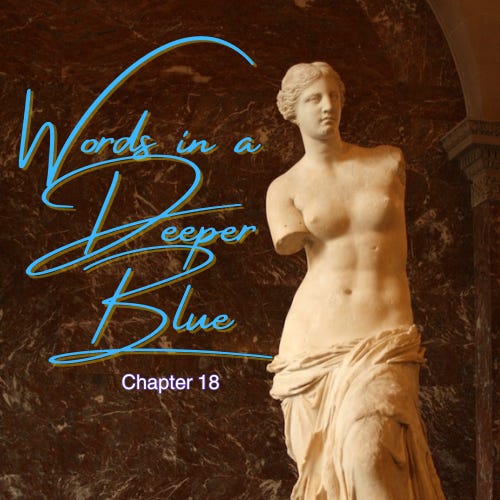
“I need to visit the Galerie des Antiques,” I said to Izzy as I pointed down a long passageway that led to a room lined in grey and red marble. The statue of Venus de Milo was on a pedestal in the middle of the room. “Would you please stand over there and let me take a few shots?” I wanted to test my Leica and Hasselblad cameras in that lighting.
Izzy was wearing a sheer white blouse and a cerulean miniskirt. She pulled her hair up behind her as she looked off in the distance with her neck at the same angle as the statue. Although there were tourists around, no one dared enter the space while Izzy was there. A couple of them snapped surreptitious photos.
“Have I ever told you how much you look Venus de Milo?” I asked as I clicked through a roll of film.
Izzy looked directly at me, pulled a ribbon from her hair, and threw it at me. I took the final shot on that film roll. It was my favorite.